Lugs, Chains, and Paddle Blades

With these three modes we explore the natural world around us. The lugs of our shoes, the chains of our bikes, and the blades of our paddlecraft.

This is our archive of amateur exploration.

Enjoy!

Thursday, March 28, 2013

Gringo3


Part III
Setting off from Esperanza

The third and final day of competition was based on the island of Vieques, 8 miles due east of one of the main island's bigger port cities, Fajardo. A private ferry whisked us to our destination while flying fish ripped across wave caps. Once on the small island we made our way to the town of Esperanza, the smaller, quainter of the island’s two towns where we were picked up by a small dive boat. Buzzing past rocky coral cliffs topped with lush hurricane-proof vegetation, our captain pointed out some of the more remote and hard-to-reach white sand beaches. We didn’t see a single person or inland structure for miles and when the anchor dropped to the seafloor beneath us, the sun began to bake us to crispy perfection. It was then that we were given the instructions for our next challenge: snorkeling.

In my mind, I always saw snorkeling kind of like I see golf. The activity moves – as it should – at a snail’s pace, and to get the best of it, one needs an expansive travel budget. I had heard of speed golf and saw that as a way of springing things up a bit, and that’s just what they did for us in the clear water off Vieques. Our leader gave each of us a printed copy of a satellite image. Superimposed over the image was an x marked by “you are here,” and a shaded circle of about a half mile
Climbing the Coral
away. “There is a plastic box on the seafloor in this circle somewhere,” we were told, after explaining that each of our names was written on a note inside a small waterproof box that had been anchored in the 20-foot water. Each of us had to find our own box, detach it from the rope anchoring it to the bottom of the sea, and return it to the dive boat. We donned our masks and flippers, dropped into the ocean, and waited for our starting command.

I was annoyed by the fact that this competition would be influenced in part by luck. I knew there were three cases attached to the seafloor, but was aware that the one who coincidentally happened upon the one with his own name in it would likely be the one to win the event. The only way to push to odds would be to arrive at the location of the boxes first. Oh, and I have a really lousy stroke and truly hate swimming.

Inverted Aerial - Navio Beach
Swimming at the quickest pace I could muster while wearing a snorkel was a challenge but it was diminished a bit by the scenery – most of the colorful fish scattered from me but the rays just ignored me as I swam past. A half mile is a long way to go in open seas in my book and I had to stop to check my heading frequently.  Reaching the boxes within a minute of each other, the three of us swam a 3-dimensionally chaotic course between points on the surface and the sandy bottom, gasping for air after each ear-popping descent. By the time we found our boxes and returned them to the dive boat our lungs were ripe.
The Navio Run

Our second event of that long day came after discovering the current winner of my personal lifelong quest to find the best fish tacos in the world (though based on the number of diners at Duffy’s in Esperanza, they don’t need a plug). While we digested, it was explained to us. Following a ¼ mile sprint across remote and beautiful Navio Beach, we’d rock-scramble our way up one of the sharp coral bluffs bordering  the soft sand, out to a 10 foot overhanging bit for a flying leap into the aquamarine waters. Then, a swim to three moored kayaks awaiting us would wrap up the stage, and the third stage, a kayak race, would come next.


Eight months later, I was back in Esperanza, eating those fish tacos once again. I’d won the return trip for two, but instead there were three of us.

To be continued . . .

In the next part: gringo tourists are welcomed with open arms when carrying red-headed white babies

Photos: Moncho Dapena & Ryan Bair


Production Assistants messing around in Esperanza


Tuesday, March 26, 2013

Gringo2


Part II

Day two brought us to the island’s interior. The elevations in the mountainous regions of Puerto Rico rise above 4000 feet, creating a system of rivers and creeks as steep and voluminous as many of those back home. But, it's a jungle. 

Near the village of Utuado our convoy of production assistants and technicians parked the vehicles and began a trek into the jungle. Locals had been hired to carry cameras, sound gear and (fortunately) lunch into the jungle.

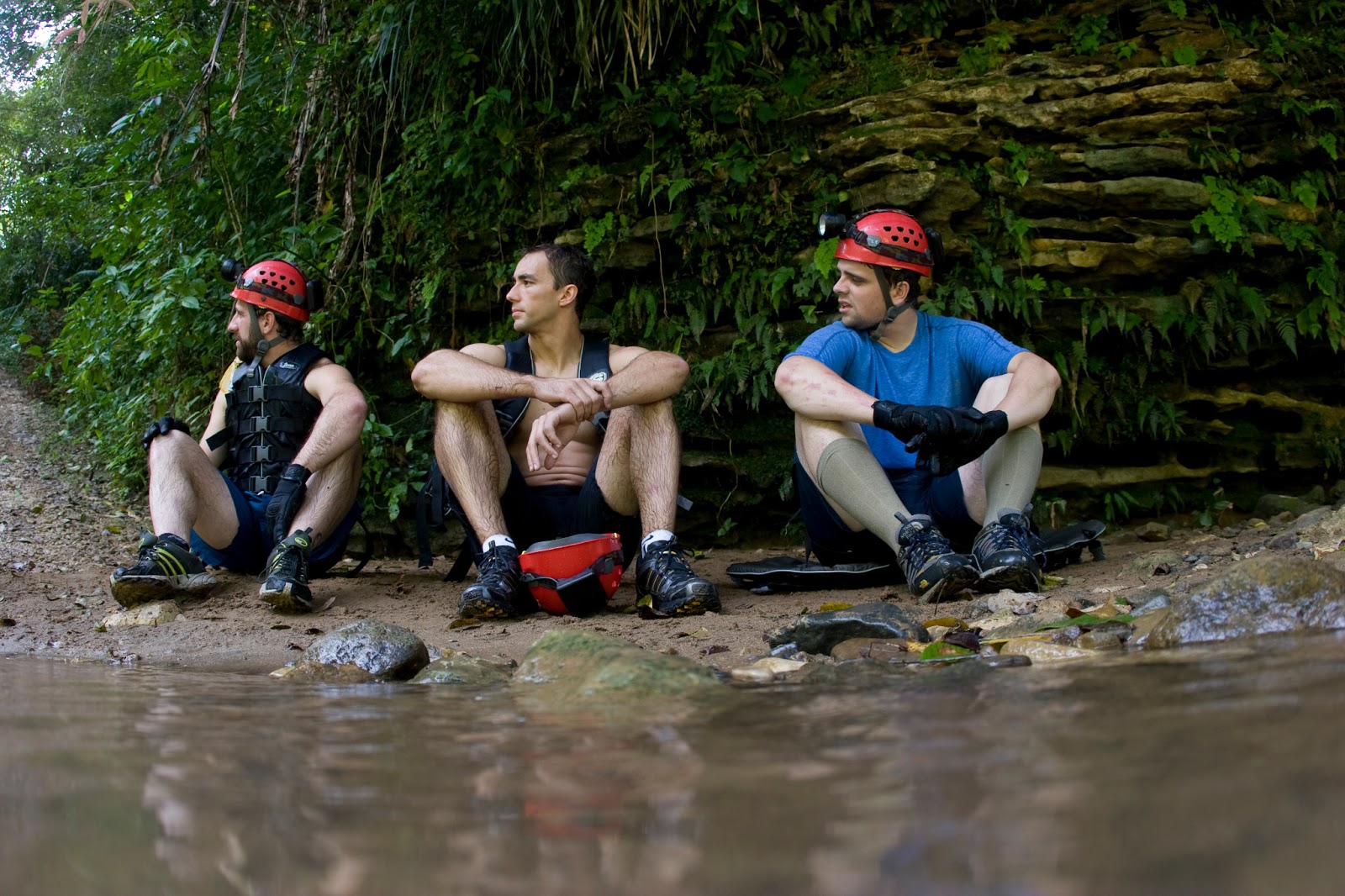
A few miles later we were deep in the canyon of the shallow, rocky Tanama River. After the people in charge spent half a day telling the others what to do while we sat around, we were given our gear bags for the day. Each one contained a life jacket, helmet, and a headlamp. We were ready for our first event of the day: run the river (on foot, that is). They called it canyoneering. Splashing through the sometimes deep, sometimes shallow water, dashing across rocky beaches, and leaping off boulders into the calm pools is what they meant by river navigation. I am used to selecting lines downriver through whitewater in a kayak; I was now faced with a different kind of line selection: whether to take a dry line across a rocky bank or run through the river. Dry lines presented serious ankle-twisting risks and progress on foot could be hindered by giant boulders, but I didn’t know how deep the river was in most places.

The three of us ran at full-tilt through a canyon several hundred feet deep. The canyon’s walls were lined with swinging, vine-like roots reaching from the canyon rim to drink the waters of the Tanama. Each bend in the river presented a new decision to make and a new natural system to take in.

Swimming? Wading? Racing!
Truthfully, the competition became secondary to me as I ran the most stimulating and fun mile of my life. I was Indiana Jones running from a mob of angry natives; Tarzan sprinting through the jungle to rescue Jane and after what seemed like an instant, I rounded a corner to find a man standing in the riverbed with two arms outstretched: our finish line. 

At that moment I became suddenly aware that Zak was immediately to my right, running across a gravel bar as I swam/waded through thigh-deep water, scraping my fingers across rocks with each half-assed stroke. Through pure luck I found a shallow spot, rose to my feet, and began my sprint. We both dove for a photo finish, crashing and splashing into the inches-deep Tanama. I sat in the water and let it cool me while I gazed back at the remoteness of where I was.
The Cave

For the second leg of the day’s competition the entire crew moseyed downstream. I took the opportunity to float on my back in the Tanama, slowly moving downstream and looking up at the sliver of sky at the top of the canyon. Before long I was behind everybody and holding up the entire production.

One last bend in the river revealed a 100-foot high cave through which the Tanama runs unobstructed. The cave exit was not visible at first giving it an eerily mysterious, terminal effect from upstream. And, once inside the cave, a hard look at the high ceiling provoked a confusing pattern of lights and darks that ended with the realization that there is a vertical exit from another cave above us that leads to a dry entrance halfway out of the canyon. This place is a crazy and complicated system of caves, rocks, tunnels, and water.

A canyoneering obstacle course was described to us, which was intense and unnecessarily dangerous (I was becoming skeptical of our hosts). Our leader pointed to one of the small waterfalls shooting off the canyon wall. Swinging from the apex of the 50-foot falls was a chain ladder.

After climbing the ladder, we’d bushwhack to a trail and then run to the top of a different cave entrance (this one about 40 feet). We were to rappel down to the foot of that cave's entrance, and then embark on a a headlamp-assisted sprint through the cave to the brink of a 125-foot drop to the river below. That last drop was enough to make me glad that I hadn’t eaten much.

The Rappel from the top cave.
Without question, this competition was fool-hearty and completely unsafe. For starters, rappelling (twice!) in a race is risky because you don’t want to rush your initial attachment to a rope. But, to race through a cave, fully aware that at some point the floor would drop to nothing but thin air for over 100 feet? What if I tripped? Was this a race to the death?

Zack, Mike, and I made a pact to not compromise safety. I'm pretty sure none of us stuck to it, though.

It took me about 8 minutes. The memory of it is a tactile mesh of thick vegetation against my legs and torso, the grit of sandy dirt in my hands, the thunder of a waterfall beating down on me, and the enormous gulp I took before launching myself into the highest free-rappel I’ve ever considered. And, I’m afraid of heights.


To be continued . . . 

Next Part: a snorkel competition, beach sprint, and (almost) marathon kayak race. Stay tuned!

Photos by Ryan Bair

Git r dun!

Tuesday, March 12, 2013

Gringo

GringoBus
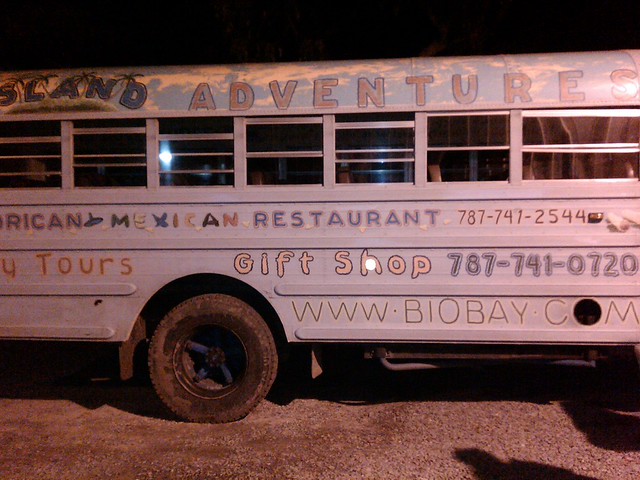
Being a self-proclaimed amateur adventurer, I generally avoid being corralled into a converted school bus,when I could just as well be participating on my own accord. Maybe it’s snobbery, but I guess I just like to explore the natural world on my own, guideless. So, when I found myself in Esperanza, Puerto Rico, a passenger on that school bus gleefully coated with the words Island Adventures, Bio-Bay Tours, Snorkeling, Kayaks, Puertorican and Mexican food hand painted in bright bubble letters over a pastel backdrop while I was holding a small life jacket and towel, I had a small panic attack. This is so not me. Surely the locals were saying to each other, “there goes another bus full of gringos!”

It had started a year earlier when my friend, Mike, told me about a contest being held by Mens Journal magazine, suggesting we both enter. “I’m not a beach guy,” I told him, “and I don’t really feel like putting together a video of myself; that’s too much work.” Mike proceeded without me and when it was ready, he showed me a well done but simple sequence of still photos that ended with him riding his bike into the camera and asking, “which way to Puerto Rico?” To provide contrast, he asked this question to the camera on his urban neighborhood street in Washington, DC with cops speeding past in the background, lights flashing. It was paradoxical, interesting and funny and the entire video looked simple to produce.

Before long I had produced my own video, just like Mike’s, of me climbing and paddling whitewater. I laced together a slideshow of my favorite moments captured on film and ended it, just as Mike had, with the question, “which way to Puerto Rico?” I'm posting it here, despite its embarrassingness.

It worked. Mike and I were both picked as contestants for the Explore Puerto Rico Challenge. We’d be going to Puerto Rico along with a third entry to compete in a host of events “such as mountain biking, caving, ropes, snorkeling and swimming, surfing, and paddle boarding, as well as other activities.” I'm fairly certain that not many others entered the contest, because another friend was coincidentally there shooting photographs.

Paddle boarding? Snorkeling? I live in Pennsylvania and I play in the mountains. I had sworn off caving years ago after being jammed into a cave that tapered down to about14 inches of vertical space. I remembered that and freaked out. I considered a polite thanks-but-no-thanks but my travel-savvy wife would have no part of it. It was about time, she encouraged me, that I have an adventure outside the Appalachian Mountains. The prize, an all-expenses paid return trip for two, may have had something to do with her pressure.
 
Trash-talking began, well promoted by the writing staff for MJ. I was asked for a few comments and somehow I replied with this signature line: “in the pure sense of adventure, the one to finish first is often the one leading the others.” This was published in the magazine even before the competition and I was relentlessly prodded.

“Isn’t that like saying, ‘the team with the most points wins,’” my brother Marc asked me.

“Sure, but I didn’t want to come off sounding arrogant.”

"I think you came off sounding like a knucklehead."
 
Zak
The third competitor, Zak, had said “I’m in the best shape of my life and I’m ready to dominate the competition.” After reading this, I was happy with my knucklehead remark. But, Zak was not lying and judging by his photo he could finger-flick my head off. And, he was well-versed in something I’d never heard of: Cross-Fit. I Googled it. “This guy’s going to crush me.”


After a late night flight and 5 am wake up in San Juan, the groggy team saddled up. Each day of the competition began with a gas station breakfast. Then, the next 6 – 10 hours were spent driving to a location and then waiting around for cameras and other equipment to be positioned. There were production assistants, photographers, and cameramen. There was a sound guy. And, there was even a host, a nice guy named Zay Harding (Google him; he's been around). Then, there were three people to tell all of those people what to do. 

Mike, Zak, and I became comrades in those hours of waiting.

Waiting


At a pre-competition meeting we were given schedule of events. Day one would be a mountain bike race. Day two’s stages would include “river navigation,” climbing, rappelling, and caving. The third day’s races would include snorkeling, running, and sea kayaking. Paddle-boarding did not make the list, but somebody said the ‘c’ word, and I was already shaking.

“There’s no way I’m getting in a goddamn cave,” I told Mike.

We were also given a point system and I deduced that could completely tank the caving event altogether and as long as I mostly swept the others I could win the free return trip. This last bit, sweeping, didn’t seem all that likely when I looked at Zak.

And we were off.

On Puerto Rico’s west coast lies the center of the island’s surf scene, the small town of Rincon. At a popular break called the Domes, the beach is shaded by a thick forest riddled with mountain bike trails. Those trails were closed all day long for our three-dude event. The three of us were each given a junker of a mountain bike and told to let ‘er rip.

“I’m worried I’ll break this bike,” I told one of the production assistants.

“Go ahead,” he replied, and pointed to a nearby truck holding about twenty more brand-new junkers. "We've got it covered." I pulled out a bike tool and began to adjust the bike to my liking.


Entering the forest at the Domes

The race against Mike and Zak took several hours, far less time than we spent waiting around for the race to begin. It was worth the wait. I’ve been mountain biking since around the time mountain bikes were new. I’ve sought out singletrack gold in the mountains all over the Central Appalachians and now live adjacent to (arguably) the best single track in the area. But, coming out of thick woods after blazing through rooted and rocky descents and steep, healthy climbs to see a crystal clear 8-foot pipeline crashing over coral and sand was otherworldly. 

The sea winds cooled me off on my way to another loop through the Domes trails and to another lap in the mountain bike race. At the end of the race, we thanked the local bike shop support and our electronic caravan of lights, cameras, and microphones headed to the nearest dive for local gastro-cultural bliss.

To be continued. . . . 

Next Part: Enjoying the island's mountainous interior and dropping 125 feet out of a hole in a rock.

Photos by Ryan Bair 
(except the first one, which was hijacked from the Internet, and the video, which I made and it's supposed to like amateur work, honest)


Git r Dun!


Now You're Waiting

Sunday, February 17, 2013

Sledding the Fern Hollow Chute


Like skiers of the backcountry, serious sledders assess a wooded slope for the optimal ride. We scan the slope for a continuous tree-free course from top to bottom because when you’re sledding, trees can really get in the way. In 1990, a tree fell on the slope into Fern Hollow in just the right spot. The lucky kids in the neighborhood were treated to Mother Nature’s most perfectly designed sled riding hill ever.
There was one pathway into Fern Hollow that had no obstructions, and halfway down that pathway was a 10-foot long flat spot. The big oak tree dropped right at the edge. To the untrained eye, it was a dead tree in the woods. But to the children who lived in the neighborhood, it would be a natural event more important than the Steelers winning the Super Bowl.
We looked forward to riding the Fern Hollow chute all year, and after the first snow of the season, we had to spend a day getting it ready. We piled snow on the uphill side of the dead tree, creating a ramp. Then, the chute itself needed to be carved into a mostly straight, continuous groove with sled-guiding berms, bobsled-style. All day long we dragged sleds piled high with snow to the chute. Like miners we robbed most of the park of useable snow.
Then we moved on to safety.
The Fern Hollow chute was double-black diamond, class 5 sled riding. Snow was piled up at the bases of the two trees lining the steep landing zone to divert errant sleds. Spotter’s platforms were cut into those piles so that a person could do the redirecting when those errant sleds were airborne.  Spotters redirected manned sleds mid-flight regularly.
Once in action, the chute was simultaneously a stellar snow-engineering feat and a death-defying daredevil act. Not a single parent ever saw the Fern Hollow chute, and for good reason. The sled of choice – an enormous innertube from a tractor trailer wheel – made for a softer, safer run.
A run down the chute started high up on the hillside. After swallowing all sensibility and summoning all the courage he could, the sledder would lay head-first, belly-down on the tube. There was no controlling the tube as it accelerated down the chute, and there were no brakes. By the time the sledder reached the flat spot, tears were streaming down his face from speed though the cold air. Then, with no grace whatsoever, the speeding tube would launch off the ramp over the dead tree just as the hillside dropped from underneath.
Everybody was silent as the tube/boy flying object soared. The only sound was the crystalline spattering of snow flecks hitting trees and hard-packed snow. Spotters stood ready.
The hillside below the dead tree was at least 25 feet long, very steep, and perfect for landing such a craft in these conditions. However, long flights at high elevations packed a devil of a landing, and novice sledders often bounced right off the tube upon impact. Eventually, we all knew to hold on with a death grip.
At the bottom of the slope, the Fern Hollow chute emptied into a field devoid of trees and other obstructions. After flight, the sledder could relax in a 40-inch diameter bed of inflated rubber and breathe easily as the tube slowly came to a stop. But, nobody ever sat for long because the next guy couldn’t wait to get his turn on the tube.
The chute was never run on anything other than the innertube; it would be suicide. Plastic sleds were much faster, most likely launching the sledder into the treetops. Then, the landing would be too harsh without the plush shock-absorbing tube.
Winter after winter the Fern Hollow chute gained notoriety and fame in the neighborhood. Little brothers and younger neighbors were groomed into the chute building efforts after training and then, only after they’d witnessed several runs, were given the go-ahead to sled. Any kid who suggested that they need to first ask a parent was shunned.
The chute lived on for several years, and while on winter break from college, many came back to ride it. Or, as in my case, if you went to a local college, the chute was a perfect way to show your out-of-town college buddies how tough we were around here, which worked for most guys.
Except for Teddy.
One winter day, after a sled riding session at the Fern Hollow chute, I told my friend, Mike, about it. Mike, in turn, told me about Teddy.
Teddy was not soft and fuzzy, but short and stocky. He looked like Tom Cruise. He wasn’t cocky or arrogant or confrontational; he was friendly and very, very energetic. And, he was known as the most gonzo and serious sled rider ever.
Everybody loved Teddy’s enthusiasm. Mike introduced me to Teddy, “This guy wants to ride your sled hill.”
“Yeah? We can go tomorrow.”
And so I arranged to bring Teddy to the Fern Hollow chute.
“What’s he going to do with that?” asked the regulars when they saw Teddy walking to the chute carrying his plastic sled.
“I tried to warn him,” I said, and figured he’d abandon it after witnessing one run down the chute.
“This is my sled,” Teddy said. “I’ve been riding it since I was a kid. They don’t make them like this anymore.”
Teddy showed off the sled, a blue hollow-form plastic sled with black handles on the side. The handles had levers that would drag in the snow when he pulled on them. Pull one to steer, two to brake.
“Dude, you’re nuts if you’re going to ride the chute on that thing. You’ll fly right over the spotters!”
This was actually not a ridiculous concept. Because of the steep hill after the launch log, the first spotter was well below the top of the ramp and sledders with good runs would often soar past at chest-level.
“Let’s see what you guys have got here,” Teddy responded innocently.
After seeing a few runs of the chute on tubes by regulars, Teddy was visibly excited. “I can’t believe that tree! You couldn’t have asked for a more perfectly placed log!”
We all smiled proudly, as if we had something to do with the placement.
Teddy joined in and ran the chute on the innertube with us a few times. He worked the safety chain: after his turn sledding, he was the bottom spotter. Then, he moved up to first spotter. Then, he stood at the log to make sure sledders were on course going into the ramp. Lastly, he was on deck and held the tube for the sledder. All the while, he passed the tube up to the next position in the chain, until it was his turn.
Finally, Teddy had seen enough.
“This tube is too slow. And, the chute could start much higher up this hill; up by that tree. That way you’d have more speed going into the ramp. This is going to be awesome!”
We stared at him, each of us thinking one of two things: this guy is going to kill himself, or, who invited Richard Petty to the soap box derby?
I was thinking the former, that Teddy was about to be its first casualty and began to worry about what would happen after somebody died while sledding the Fern Hollow chute. I tried to make peace with this being our last day on the chute. It would surely be outlawed.
“Woo-hoo!!” screeched one of the younger, less experienced regulars. “Let’s do it! Let’s make the chute higher!”
For some reason, we all decided to pitch in and build the chute higher for Teddy.
“See, now we don’t need anybody to hold the sled!” cried Teddy from the new chute origin as he held onto the only tree preventing him from making it even longer. “This is gonna be sick!”
Everybody scrambled into safety positions. Spotters held their positions at the trees. Two of us stood at the ramp to keep Teddy on course.
“3 – 2 – 1 – here goes!”
Teddy sprang to his feet and jumped high and far down the chute, giving himself even more speed. Everybody who had ever run the chute had done so from a stand-still, 20 feet lower on the hill, on a cushy, fat inner tube. Richard Petty was here indeed.
About five seconds later, Teddy had sledded himself into neighborhood folklore. He approached the launch log perfectly without even a touch of steering from the sled’s black handles. He sped up the snow ramp effortlessly, unlike the innertube which lost momentum there, but his sled angled slightly just as it took flight. Then, as predicted, Teddy soared over as the spotters looked up at him.
But Teddy had a slight angle to the left coming off the lip. So, he worked hard mid-flight to correct it, pumping his sled to the right, away from his outstretched body, in an attempt to change course. His attempts were unsuccessful. Time slowed as we watched Teddy fly out of control, struggling and twisting.
When Teddy landed, only half of his body was on the sled and he had overshot the entire landing zone. As he descended from the stratosphere, he lifted his head up high to keep it away from the sled. He landed hard onto the flat field, which was covered in snow packed down from run after run and his face slammed into the snowpack. Because he was not completely on the sled, the hard edge of it smashed into his sternum before he rolled off.
Everything was quiet. We had just witnessed the most spectacular feat in sled riding history, but unfortunately our new hero was laying face down. We waited. Then, moaning. Motion.
Teddy rolled on to his back and lifted his torso. Blood covered the lower half of his face and was running down his neck onto his coat. He put his hand up to his chin and looked down at the blood on his glove. He held his bruised chest with his other hand.
“Oh yeah!” he shouted in a voice much lower than normal, drawing it out at the end, and raised a fist into the air. We cheered, whooped, and hollered for Teddy and ran down to pat him on the back.
Then, as the chest thumping subsided, Teddy looked down at his sled. Long fingers of blue plastic crossed at the edge, where Teddy’s chest had crushed it to splinters. I smiled with a bit of pride. Richard Petty’s car couldn’t handle our track.            
As Teddy walked away from the Fern Hollow chute, he dragged behind him his useless, broken sled. Nobody ever ran the Fern Hollow chute on a plastic sled again.

Wednesday, February 13, 2013

SLAG


There’s nothing romantic about slag. At least, that is, not in the material itself. It is a far cry from a precious stone, not even useful like coal. In Pittsburgh’s era of steel, the city found itself with more of this byproduct of the steelmaking process than it could handle. It was discarded into mountains alongside the Monongahela River, right across from the Homestead Works. For decades the heaps of hard packed gravel-like substance have remained; a barren industrial wasteland of unnatural peaks and little vegetation.

In 1986 I was twelve years old. Like every boy with a penchant for exploratory adventure, it was my turn to do my own survey of the slag heaps.

It was like the Wild West. A dry, empty landscape with no rules. Who owned the slag dumps? Nobody knew. I took my first tour of the slags with Jay Cravotta, a kid much tougher than me. Our fathers were close friends so I trusted he wouldn’t ditch me back in the no-man’s-land on the other side of the big fences posted with NO TRESPASSSING signs. Brian Cusick was with us, too, who probably fit my category better than Jay’s. We were both nerdy, scrawny glasses wearers with just enough of a sense of adventure to ride our bikes past those signs. Jay tolerated us, I’m sure.

Jay told us about the “hole,” which he described no further than that: a huge hole in the ground. I was imaging flames of eternal damnation licking at the edges. Pedaling our bikes across the sometimes packed, sometimes granular slag, we passed burned out cars, twisted girders, train car axels, and heavy cable, completely ignorant of the risk of laceration, infection, or falling. We were on an adventure, with no more sensibility than our adolescence would allow.

At the foot of one of the larger heaps, we dropped our bikes and began a crawling ascent up a 40 degree pitch. Jay told us that the hole was at the top. Loose slag rolled down the slope and created harmless little avalanches. At the top we stood at the edge of a pretend volcano with dozens of discarded tires instead of molten rock.

Quite disappointed, I began to fabricate my own tall tales of the hole as we slid back down on our bums. My mind was already making the hole into a bigger deal than it was.

We continued deeper into the barren slag wild. All around us were peaks. Beyond them, our imaginations told us, was unknown territory for us to explore. We came to a small stream devoid of signs of life. A bridge – a mesh of railroad ties and iron – was no longer in use but stood before us as the most exciting way across. We could not ride over the bridge on our bikes. That would be suicide because gaping splinter-lined holes gave way to a 20-foot drop to the creek below. In some places, brittle, rotten plywood covered the holes, but only made passage appear to be even more treacherous. We scampered across, pushing our bikes, sometimes walking on one railroad tie while pushing the small pedal bike across another.

As we rode away from the bridge and into a drainage ravine that winded its way to the top of another huge slag pile, all three of us were silent. The sounds around us were manmade, unnatural. Cars purred across a highway bridge in the distance. A train slowly chugged along the banks of the river below us. A tugboat heaved a load of barges to market downriver. We were, after all, not in the Wild West, but on a heap of gravel overlooking the Mon River and the Parkway East. Our bike chains squeaked and our tires crunched as they searched for traction.

At the top of the incline we stood on a vast lunar plateau. Post-apocalyptic scenery was everywhere: burned and rusted vehicles, mattresses, furniture, and appliances. Evidence told us of huge bonfires with dozens of participants sitting on seats improvised from wood, TVs, washing machines, upholstered furniture, or chunks of slag itself. The thought of the place blazing at night was simultaneously exciting and terrifying.

We rode the moonscape for hours. Exploring every corner for artifacts meant riding up and over berms, ramps, and mounds – all made of slag and littered with junk. Our bravery began to increase as we jumped over broken metal and fire pits.

Before long we were exhausted and ready to make our descent. It was wild and dangerous, down a V-shaped ravine that presumably drained the plateau after it rained. Helmets were uncool and generally not available in these days, which made the “Babyhead” sized rocks that were everywhere as we flew down the ravine even more dangerous.

We approached the river and found the mythical Skeetersville. Several dozen homes, and nothing more, make up this small village trapped between the Monongahela, Nine Mile Run, and the slag heaps. In my 12-year old mind, Skeetersville residents had no reasonable way out. They had to either wade through the creek, walk across the train bridge over the creek, or hike through the slags to get to civilization. That each home had a driveway with a car in it never enlightened me with reality. We rode through town like young guns.

Then we did something really stupid.

From Skeetersville, we biked along a pair of railroad tracks, which cross Nine Mile Run on a narrow bridge. It is a short bridge and the acoustics were telling us there was no train nearby, other than the one that was standing stationary on the second set of tracks. And so, as stupid adolescent boys have done since the dawn of humanity, we pushed our luck. Imagine it: three kids crossing a train bridge on their BMX bikes. One track is empty, the other in use by a rusty stack of freight cars that hadn’t moved in decades. The width of the bridge: wide enough to hold two sets of tracks, no more. What happens next in this story? Of course, a freight train barrels down the tracks at the three kids.

We escaped death by locomotive not by outrunning it a la Stand By Me, but by tossing our bikes and then our bodies underneath the massive stationary train and laying down. In retrospect, we should have jumped off the trestle into the creek and simply risked injury. There I laid, looking down between planks at the creek. Two feet in front of my nose, thousands of tons of freight train thundered past, car after car. The noise was deafening and the bridge shook like it was about to give. All I could see from my position was the bottom half of the wheels of the monster as it rolled past. The train went on forever, and I cried. Fortunately nobody saw or heard. I don’t remember anything else about that day, not even how I got home.

Twenty-five years later I am a frequent slag heap visitor. Half of the region – the post-apocalyptic lunar plateau – has become a development. Apparently a clever engineering firm figured out how to build homes on top of slag. The other half is now home to some of the best mountain biking this side of Moab. Or, at least this side of Skeetersville.

Git R Dun!

Saturday, April 28, 2012

Transcontinentalitis, Days 41 & 42 (Victorville, CA to Newport Beach, CA)

Day 41: Victorville, CA to Yorba Linda, CA (85.9 miles, 3171.1 total, 44.4 mph max)

We're in Yorba Linda, CA at my cousin Marie's house. I feel more comfortable here than ever on this trip. Today was easy. We found our way using people's directions and kind of guessing. Not a bad ride at all.


San Bernardino was pretty rough. Not a place I'd like to stop for long. California is different. As soon as we crossed the Cajon Pass we could feel and smell the ocean breeze. It was the most incredible feeling, and I was ear to ear with smiles. What a great trip.


Tomorrow we'll ride to the coast and back. I'm so excited.

Day 42: Yorba Linda, CA to Newport Beach, CA (~30 miles, 3201.1 total, 40 mph max)

Well, now it's official. We biked to the Pacific Ocean. The bike trail was nice; it's kind of neat that we started and ended on bike paths. 

I'm very proud of myself. I think I deserve it. This trip was a dream of mine. I don't think I've ever accomplished anything that I'd dreamed of doing like this. What an incredible feeling. 

I need a new dream now. I'll think one up soon, I'm sure. I can't wait to tell stories.

Now we start up the coast, but we won't do that for awhile. 

Total trip distance: 3201 miles. It doesn't feel like it was that much, though. 

I hope I have this feeling again someday. 

"A brilliant idea never starts out brilliant. It starts out ridiculed, because nobody has ever seen anything like it before. Be unreasonable. Insist that it can be done. Show them how"

I never forgot these words; they're from a commercial I saw. I memorized them so that I could write them to all the people who didn't believe I'd really do it. Well, I'm not going to do that, but I know they won't doubt me again.
 I told them I would ride my bike the California and I did it.


That's it! I couldn't be more thrilled to be done with this transcription. For two weeks, Chris and I enjoyed ourselves, couch-surfing among various friends in Southern California. Then, we started North with the ultimate goal of reaching San Francisco. The trip ended four days later in Gorda, CA, where we decided to hitch-hike the remaining distance to Santa Cruz.

In retrospect, it is an unfortunate end to the journey, but was predicated by couple of days of overly ambitious riding. Day 2 -- 100 miles. Day 3 -- 135 miles -- Chris and I thought it would be a good idea to just ignore sundown and ride into the night on the Pacific Coast Highway. Unfortunately, with no lights illuminating the roadway we were riding into pitch darkness before long. A flat caused by an unseen obstruction began a miserable night attempting to navigate darkness on the shoulder of a remote road, but somehow (I honestly don't recall how) we ended up in a campground sometime before midnight. Then, as if we hadn't learned a thing, we set our watch alarms for 5 am so that we could get up and ride another 140 miles to Santa Cruz before it got dark on Day 4.

By 9 am on Day 4 up the coast, Chris and I had ridden about 30 miles to a small cafe in Gorda, CA. It was there that we agreed to throw in the towel. I spent the remainder of the trip in the bed of a pickup driven by a strung-out teenager running away from home (seriously).

THE END.